Family composition
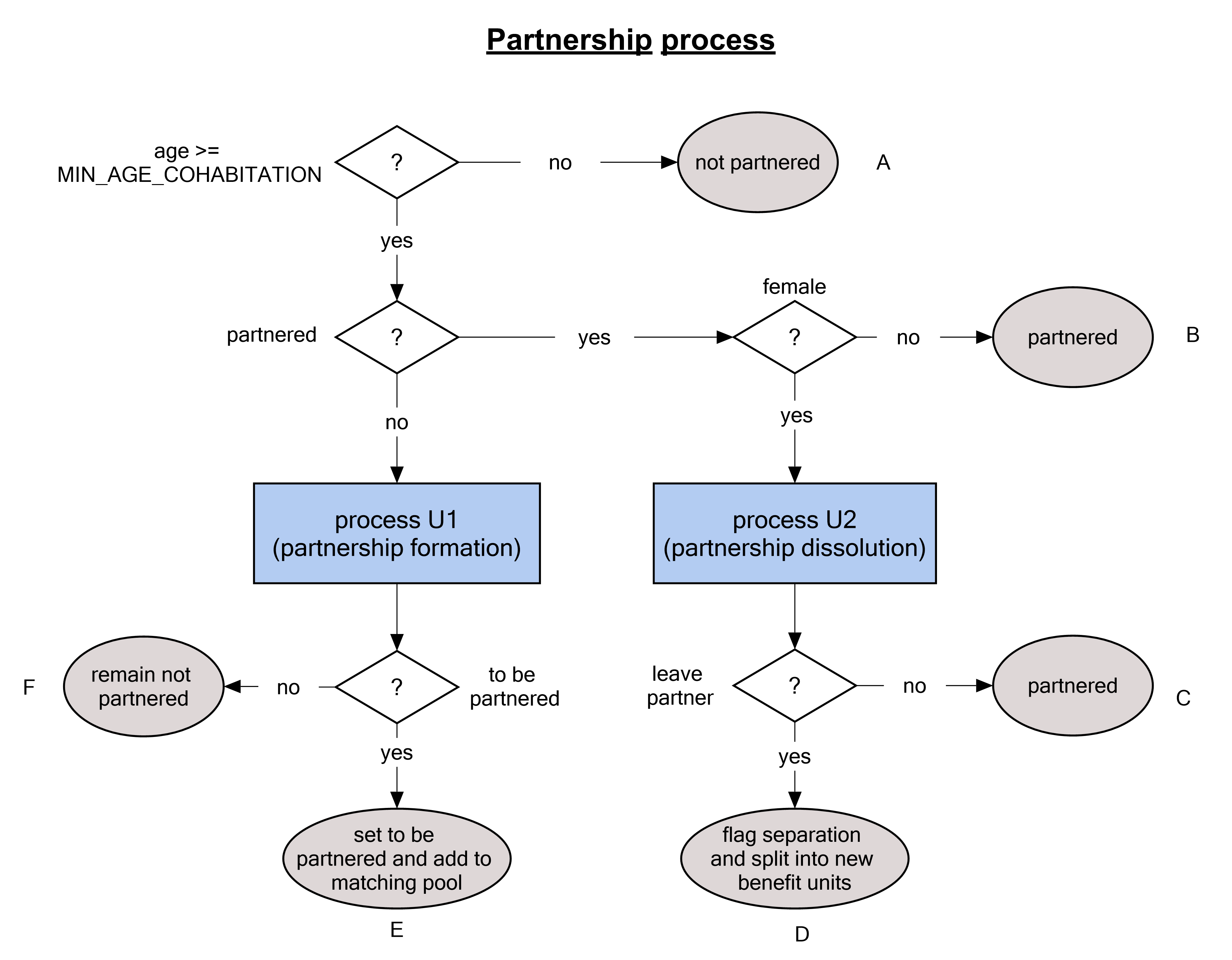
The family composition module is the principal source of interactions between simulated agents. It projects the formation and dissolution of cohabiting relationships, partner matching and fertility.
When a relationship forms, partners are selected through a matching process designed to reflect correlations between partners' characteristics observed in survey data. The proportion of the population in a cohabiting relationship can be aligned to observed population aggregates, accounting for changes in household structure introduced by population alignment.
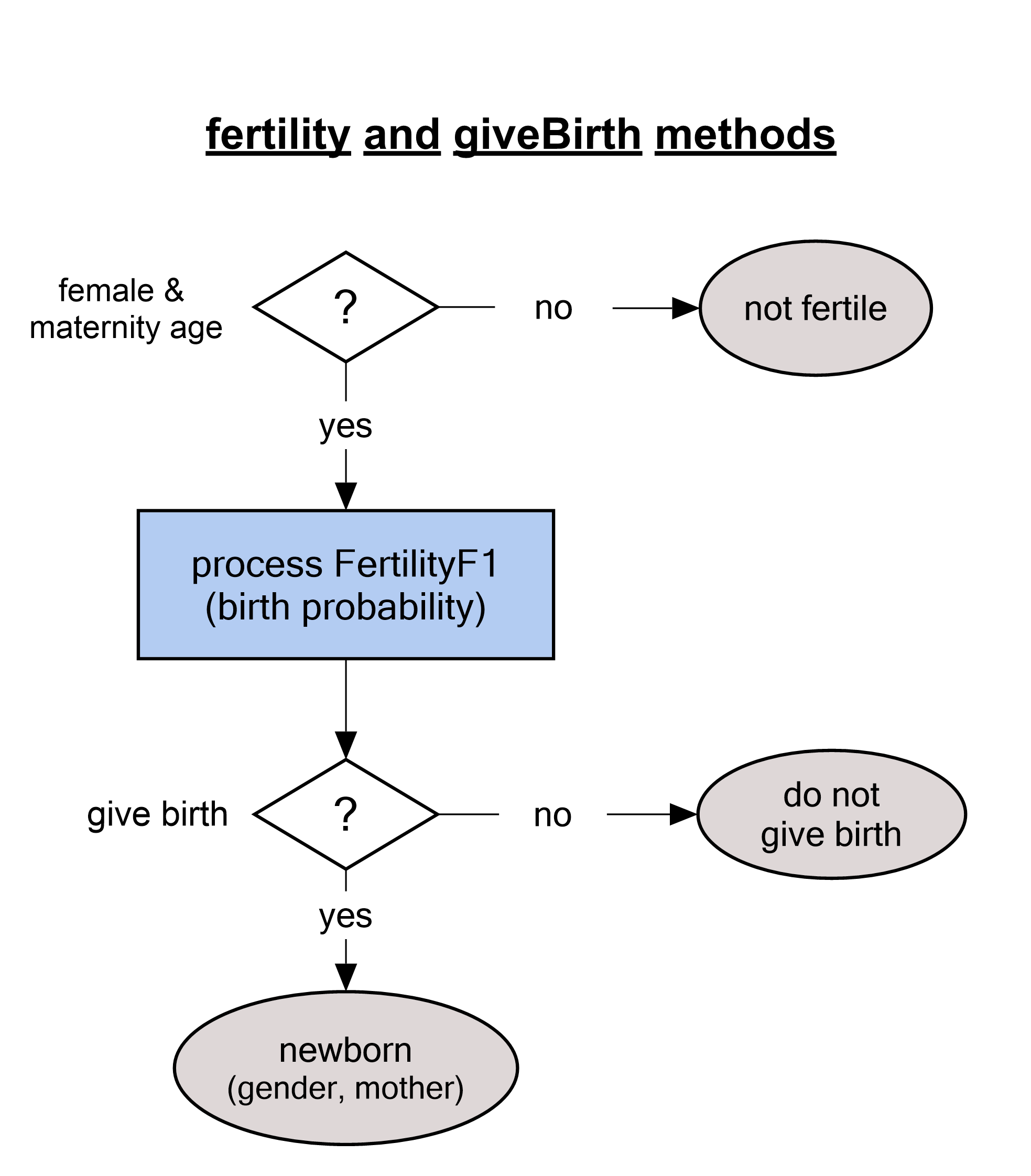
Women in couples can give birth to one child in each simulated year. Fertility depends on individual and household characteristics, and simulated births can be aligned to official projections for newborn children by gender, region and year.
Implementation diagram
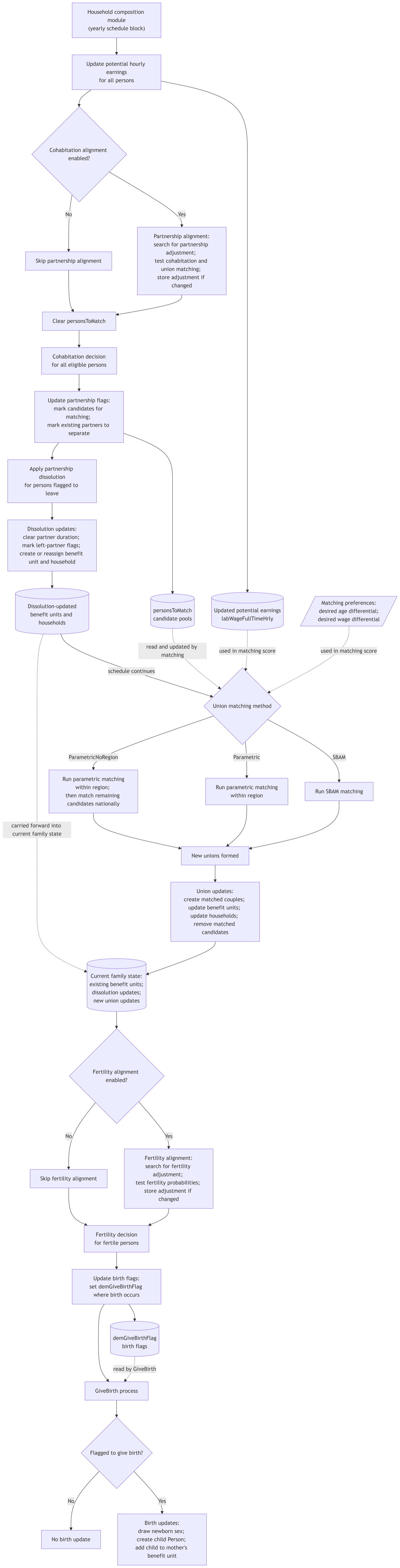
The diagram traces the module's annual implementation sequence and branching choices. It is provided here as an orientation to the processes described in the sections below.
View the family composition diagram
Partnerships and cohabitation
Individuals aged 18 and over who do not have a partner may enter a partnership according to a probit model. For students, the model conditions on gender, age, lagged household-income quintile, the lagged number of dependent children, the lagged number of children aged 0-2, lagged self-rated health, region and year. For non-students, the same variables are used together with education and lagged employment status.
Individuals selected to enter a partnership are matched using either a parametric or non-parametric process. The current processes focus on opposite-sex relationships.
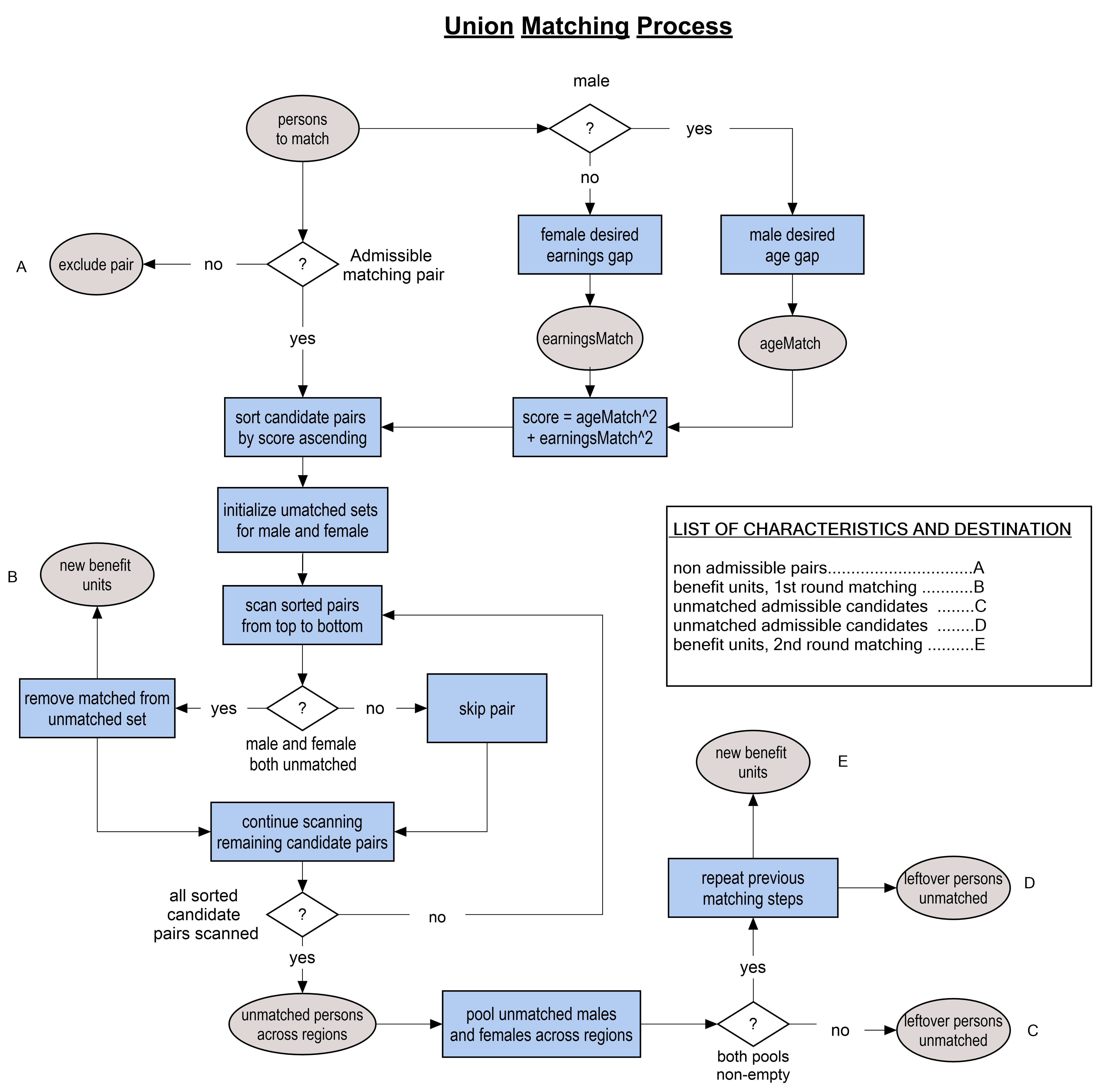
In the default parametric process, the model searches the pools of men and women selected to cohabit and minimises a score based on the distance between each person's characteristics and their prospective partner's preferred age and earnings potential. Matching is attempted within regions first. If a sufficient number or quality of matches cannot be found, the remaining candidates are considered in a national pool.
The non-parametric alternative uses iterative proportional fitting to reproduce the distribution of matches observed in survey data. A person type is defined by gender, region, education and age.
Partnership alignment
The matching process does not necessarily identify a partner for every person selected to enter a relationship. This can lead to an under-representation of couples in the simulated population. When cohabitation alignment is enabled, the intercepts of the relationship-formation equations are adjusted so that the incidence of couples follows survey targets. After the final alignment year, the last estimated adjustment is retained.
Partnership dissolution
Partnership dissolution is modelled at benefit-unit level using a probit model. It conditions on the female partner's age, education, lagged gross non-benefit income, the lagged number of dependent children, the lagged number of children aged 0-2, lagged self-rated health, the spouse's lagged education and health, the lagged difference between partners' gross non-benefit incomes, partnership duration, the lagged age difference, lagged household composition, both partners' lagged employment status, region and year.
Fertility
Partnered women aged 18 to 44 may give birth to one child in a simulated year. For women in continuous education, the probability is described by a probit model conditional on age, benefit-unit income quintile, the lagged number of children, the lagged number of children aged 0-2, lagged health and lagged partnership status.
For women who are not in continuous education, the model additionally includes the population fertility rate, lagged labour-market activity, education and region. Including the population fertility rate allows projected aggregate changes in fertility to be distributed across women according to their observed characteristics.
Birth alignment
When fertility alignment is enabled, the projected number of births is aligned to the number of newborns in the official population projections. The procedure samples eligible women and adjusts fertility outcomes until the target number of newborns, distinguished by gender and region, is met.
Technical implementation
Annual scheduling
The current annual schedule coordinates the module in the following order:
UpdatePotentialHourlyEarningsrefreshes full-time hourly earning potentials used in partner matching.CohabitationAlignmentestimates the partnership adjustment when alignment is enabled;Cohabitationthen identifies people to be considered for matching inpersonsToMatch.PartnershipDissolutionevaluates existing couples.UnionMatchingforms new couples using the selected matching method.FertilityAlignment, when enabled, is followed by the person-levelFertilityandGiveBirthprocesses.
The model-level ordering is defined in SimPathsModel.buildSchedule(). Person-level transitions are implemented in Person. See The SimPathsModel Class for the wider scheduling architecture.
Regional and national matching
SimPaths provides three matching methods: SBAM, Parametric and ParametricNoRegion. The default is ParametricNoRegion.
For parametric matching, SimPathsModel.unionMatching() constructs sets of unmatched men and women for each region and passes each regional pool to evalMatches(). Under ParametricNoRegion, unionMatchingNoRegion() then repeats the procedure for the candidates left in personsToMatch, this time using a national pool. evalMatches() creates a UnionMatching object, runs the global matching algorithm and removes accepted pairs from the candidate pools.
Pair selection and household formation
UnionMatching.evaluateGM() constructs every feasible man-woman candidate pair and assigns a score using localGetValue(). Candidate pairs are sorted from the lowest score upwards. A pair is accepted only if both people remain unmatched; localMatch() then records the match, removes both people from the unmatched sets and creates their benefit unit and household.
The matching score combines two differences:
- the observed age difference, adjusted for the man's preferred age difference;
- the observed difference in full-time earning potential, adjusted for the woman's preferred earnings difference.
Pairs involving a parent and child, or pairs outside the configured age- and earnings-difference bounds, receive an infinite score and are excluded. For an accepted pair, the woman's region is set to the man's region, partnership duration is initialised and setupNewBenefitUnit() updates the simulated household structure.
The detailed source diagrams remain available for the cohabitation process, the UnionMatching algorithm and fertility.